Best Dive Sites on the French Riviera: A Diver's Guide
From the red coral caverns of the Calanques to the great wrecks of Porquerolles and the grouper-thick reserve of Port-Cros – where to dive between Marseille and Cannes
DiveLine Team
2026-07-06
The Best Dive Sites on the French Riviera
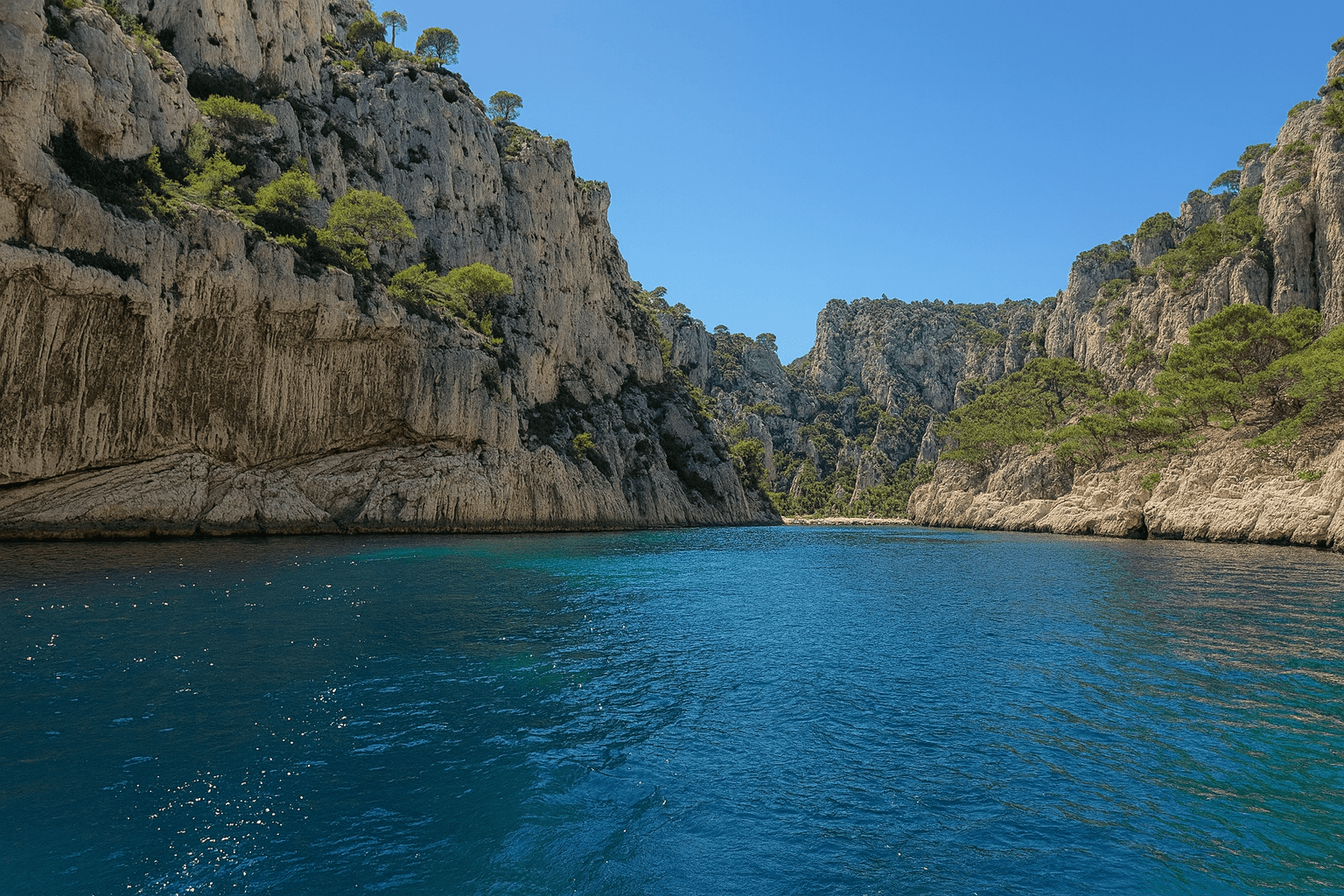
Between the white limestone cliffs of the Calanques and the glitter of the Croisette, the coast of Provence and the French Riviera holds some of the finest diving in the Mediterranean. Two national parks anchor the region: the Parc National des Calanques, which protects the fjord-like inlets and cliff walls between Marseille and La Ciotat, and the Parc National de Port-Cros, Europe's first marine national park, whose integral reserve shelters the densest population of dusky groupers in continental France. Add two of the most celebrated wrecks in European diving, red coral caverns shallow enough for newly qualified divers, and drop-offs that plunge past 50 m within minutes of the harbour, and you have a coastline that rewards a full week of diving without ever repeating a profile.
The diving here is defined by the tombant – the drop-off. Limestone and volcanic reliefs fall away in walls, faults and overhangs carpeted in coralligenous growth: red and yellow gorgonian fans, encrusting sponges, and pockets of precious red coral (Corallium rubrum). Decades of protection have brought the big fish back, and dusky groupers that were nearly wiped out by spearfishing now patrol the reserves with total indifference to divers. The sea is microtidal, so wind rules everything: the cold north-westerly mistral flattens the water under the great cliffs while making offshore crossings dangerous, and the easterly does the reverse. Local operators read these winds daily, and every port in this guide keeps a sheltered fallback for the days the weather turns.
Best time to dive: May through October. Surface water peaks at 24-25°C (75-77°F) in August, though below the summer thermocline – usually somewhere between 15 and 25 m – it can still read 15-16°C, so bring more neoprene than the surface temperature suggests. Winter diving is possible for the committed (13-14°C / 55-57°F, drysuit territory), but most centres run reduced schedules. September and October are the connoisseur's months: warm water, the year's best visibility, and far fewer boats on the moorings.
Pro tip: Check conditions on DiveLine's Cassis, La Ciotat, Porquerolles, and Cannes area pages for real-time visibility, swell, and wind forecasts before planning your trip – on this coast, knowing what the mistral will do tomorrow is worth more than any guidebook.
1. La Grotte à Corail
- Difficulty: Beginner
- Type: Boat dive
- Depth: 12-24 m (40-80 ft)
- Visibility: Typically 15-30 m (50-100 ft)
La Grotte à Corail is the signature cavern dive of Cassis and one of the most celebrated dives in the French Mediterranean. A short run west along the Calanques cliffs from the port – ten to twenty minutes with the local boats – brings you to a limestone wall that opens into a series of wide vaults and overhangs inside the Parc National des Calanques. The ceilings are the point: they are blanketed in living red coral, the precious Corallium rubrum that was harvested for jewellery across the Mediterranean for centuries and is now scarce almost everywhere else. Light spills through the broad openings and catches the coral-draped roofs, so the site feels more like a sunlit gallery than a cave – no overhead training required, just follow the cliff face and the navigation takes care of itself.
What makes the site remarkable is the depth. Red coral normally retreats to deep or dark water; here it thrives at 12-24 m, shallow enough for newly qualified divers to enjoy long, unhurried bottom times. Bring a torch anyway: without one the coral reads as dull grey-brown, and with one it ignites into intense scarlet against orange encrusting sponges and Neptune's lace bryozoan. Groupers patrol the cliff outside the vaults, spiny and squat lobsters pack the overhangs, and barracuda occasionally pass in the blue. The towering cliffs kill the mistral completely, which is why the site is so dependably calm – but when a southerly is running, surge amplifies inside the vaults, and a fin kicked into a century-old coral colony does damage that outlives the diver. Buoyancy discipline is the entry fee.
2. Tombant de la Cassidaigne
- Difficulty: Advanced
- Type: Boat dive
- Depth: 26-49 m (85-160 ft)
- Visibility: Typically 15-30 m (50-100 ft)
Tombant de la Cassidaigne is the marquee deep dive of Cassis. About four nautical miles south-south-east of the port, an isolated rocky plateau ends at the foot of the Cassidaigne lighthouse, and its seaward edge falls away in a steep, colour-saturated wall into open Mediterranean water. The plateau tops out between 15 and 26 m; the drop-off plunges past 45 m. Red gorgonians appear from 15-20 m and thicken with depth into the dense forests the site is famous for, and the base of the wall is where the region's big-animal stories happen: barracuda, groupers along the drop-off, pelagics working the edge of the plateau, and – for the lucky – a sunfish drifting in from the blue.
This is open-sea diving and it behaves like it. Currents of one to two knots can run across the plateau, and the site is only attempted in calm wind: when the mistral sweeps down the Gulf of Lion, the four-mile crossing becomes long, rough or cancelled outright. Treat a cancellation as good judgement rather than a lost day – the same Cassis operators will happily run you to Tombant de Castel Vieil instead, a stepped Calanques wall beneath cliffs that block the mistral entirely, friendly to Level 1 divers on its 15-20 m plateau while its deeper terraces keep experienced buddies busy past 40 m.
3. Le Mugel
- Difficulty: Beginner
- Type: Shore dive (beach entry)
- Depth: 8-20 m (25-65 ft)
- Visibility: Typically 9-18 m (30-60 ft)
Le Mugel is the reference shore dive of La Ciotat and the easiest entry on this entire stretch of coast. From the car park beside the Parc du Mugel botanical garden, some thirty steps lead down to the pebble beach of the Anse du Petit Mugel, a cove inside the Calanques National Park at the foot of the Bec de l'Aigle – the enormous conglomerate "eagle's beak" that dominates the town's skyline. The dive itself is a gentle rocky point laced with Posidonia seagrass meadows, sloping from the shallows to about 20 m, with navigation simple enough for training dives, night dives and relaxed solo-buddy wanders alike.
The headline attraction sits at snorkelling depth: clusters of yellow gorgonians growing at 7-10 m, absurdly shallow for a species that usually demands a boat and a deep wall. Around them the cove delivers the full Mediterranean shore-dive cast – morays, octopus, cuttlefish, red sea stars, salema and sargo schooling over the point, big mullet, passing barracuda, and the occasional seahorse hiding in the Posidonia for those with trained eyes. Because the Bec de l'Aigle blocks every wind from the north and west, Le Mugel stays diveable through a full mistral blow, which is exactly when the local clubs converge on it. Its one weakness is an east or south-east wind driving into the cove mouth, which brings surge over the shallow rock and stirs the visibility down.
4. Tombant du Bec de l'Aigle
- Difficulty: Intermediate
- Type: Boat dive
- Depth: 20-40 m (65-130 ft)
- Visibility: Typically 15-30 m (50-100 ft)
On the seaward side of the same headland, Tombant du Bec de l'Aigle is La Ciotat's standard deep outing – a few minutes by RIB from the harbour, around the rock and straight onto the drop-off. The wall starts around 15 m and falls in steps, faults and overhangs to 30-40 m, the deeper face carpeted in red and yellow gorgonian fans with pockets of red coral tucked under the ledges. Local clubs treat it as the natural progression dive once divers hold CMAS two-star or Advanced Open Water: deep enough to matter, close enough to port to be routine.
Resident groupers and genuinely large dentex patrol the drop-off, morays and congers hold the cracks, scorpionfish sit motionless on the ledges, and the rock rewards macro eyes with nudibranchs between the fans. Like Le Mugel below it, the site hides from the mistral behind the headland and the Cap Canaille cliffs, so it remains the club go-to when that wind blows; the real exposure is southerly. Deep-wreck divers should also ask about the P38 Lightning, a WWII twin-boom American fighter lying inverted and remarkably readable on sand at 38-40 m in the neighbouring bay – shot down in January 1944 and rediscovered in 1996, it is one of the most evocative aircraft wrecks in the Mediterranean.
5. Le Donator (Prosper Schiaffino)
- Difficulty: Advanced
- Type: Boat dive
- Depth: 40-52 m (130-170 ft)
- Visibility: Typically 20-30 m (65-100 ft)
Le Donator is the reference wreck of the French Mediterranean, and for many French divers simply the best dive in the country. A 78 m wine-tanker cargo built in Norway in 1931, she struck a drifting mine in November 1945 in the channel between Porquerolles and Port-Cros and went down fast – upright, intact and unbroken on flat sand. Eight decades on, the deck sits around 35 m, the sand at 50-52 m, and every surface of the superstructure, masts and giant bronze propeller is draped in dense red and yellow gorgonian fans. Dusky groupers patrol the holds, congers and forkbeard hide in the machinery, and clouds of damselfish and barbiers smoke over the structure while barracuda hang above the deck.
Respect the numbers: this is a genuine deep dive in the Grande Passe, a channel that funnels wind- and tide-driven flow into the frequently strong, sometimes violent current the wreck is known for. Dives run through licensed clubs from the Hyères area – La Londe, Hyères, Le Lavandou – or Porquerolles itself, inside the Port-Cros National Park buffer zone. Experienced wreck divers classically pair it with Le Grec (Sagona) some 550 m away, a wine-laden steamer that hit another leftover mine one month later, in December 1945, her upright stern now equally colonised by gorgonians. Two ships, the same cargo, the same cause, weeks apart: it is the most poignant double-header in European wreck diving.
6. Sec de la Gabinière
- Difficulty: Advanced
- Type: Boat dive
- Depth: 20-46 m (65-150 ft)
- Visibility: Typically 20-30 m (65-100 ft)
Sec de la Gabinière is the signature reef of the Port-Cros National Park – Europe's first marine national park, protected since 1963 – and arguably the most famous dive of the whole Hyères islands group. A large rocky pinnacle rises to within about 12 m of the surface just south of the Gabinière islet, then plunges in deep faults, drop-offs and gorgonian-covered ridges to 40 m and beyond. Because it sits inside the fully protected integral reserve, boat numbers and diver counts are capped and dives require park authorization, so you book through the licensed centres running from Hyères, La Londe, Le Lavandou or Porquerolles.
The reason everyone comes is groupers. The Gabinière holds one of the densest concentrations of large dusky groupers in the western Mediterranean, typically gathered near the thermocline, and after six decades of protection they treat divers as scenery – expect eye-level passes from fish the size of a hallway dresser. Big dentex hunt the ridges, schools of barracuda stack up in the shallows around 7 m, and lobsters and morays fill the faults. A strong, tide-independent current frequently sweeps the pinnacle toward Porquerolles, so the site is usually run as a committing drift for experienced divers. It is one of those rare places that genuinely deserves both its protection and its reputation.
7. La Tradelière
- Difficulty: Intermediate
- Type: Boat dive
- Depth: 18-38 m (60-125 ft)
- Visibility: Typically 15-25 m (50-80 ft)
Off Cannes, the diving happens around the Îles de Lérins, and La Tradelière is the classic of the group. The site is a small, low islet just east of Île Sainte-Marguerite, roughly 35-40 minutes by boat from Cannes or Golfe-Juan, where a wide, sunlit plateau at 1-5 m is ringed by drop-offs falling away to about 38 m. At the bottom of the tombant a large rock formation is draped in red gorgonian fans; over the plateau, sars and saupes school across the boulders and the surrounding Posidonia seagrass.
Versatility is the appeal: the same mooring serves an easy, sunlit plateau dive for beginners and snorkellers, or a proper gorgonian wall for divers who drop over the edge. Groupers, octopus, scorpionfish and morays shelter in the rock, and nudibranch hunters do consistently well here. If you have non-diving company or a long surface interval, Sainte-Marguerite's south shore also hosts the Écomusée sous-marin – six monumental face sculptures by Jason deCaires Taylor standing in 3-5 m of clear water over white sand, Europe's first underwater eco-museum and a genuinely worthwhile snorkel, steadily colonising into a living reef since its 2021 immersion.
8. L'Enfer de Dante
- Difficulty: Advanced
- Type: Boat dive
- Depth: 27-58 m (90-190 ft)
- Visibility: Typically 20-26 m (65-85 ft)
The name means Dante's Inferno, and L'Enfer de Dante is the premier advanced dive of the Cannes-Antibes bay. A cluster of massive rocky pinnacles rises from the seabed in open water between Golfe-Juan, Juan-les-Pins and the Lérins islands, topping out around 15 m before plunging in sheer walls past 55-60 m to a shell-and-sand bottom. Fissures, overhangs and a small grotto carve the towers, and shafts of light dropping between the pinnacles give the site a dark, cathedral-like atmosphere that fully earns the name. The walls carry dense gorgonian forests – the blue-violet species typical of these offshore reliefs, with red fans and sponges deeper down.
The fish life matches the architecture: resident dusky groupers, dentex, schooling barracuda, sea bream, and clouds of orange anthias boiling over the summits, with scorpionfish, congers, forkbeard and lobster packed into the fissures. Only a beacon marks the shallowest rock, so operators drop a shotline onto a summit and run it as a guided, planned deep dive, ten to twenty minutes from port; a sustained southerly reinforces the current and will cancel trips. Divers who want metal with their rock can add the Robuste II, a 1921 steam tug broken on the sand at 26-28 m in the same bay – an undemanding wreck alive with congers and morays.
Planning Your French Riviera Dives
The four ports in this guide string along roughly 180 km of coast, and the smart play is to treat them as a road trip. Cassis and La Ciotat sit twenty minutes apart under the Calanques, about forty minutes from Marseille; the Porquerolles and Port-Cros sites run from the Hyères area (La Londe, Le Lavandou, or the ferry from La Tour Fondue to Porquerolles village); Cannes and Golfe-Juan centres cover the Lérins islands and the bay. French diving culture is club-based and rule-conscious: bring your certification card and logbook, expect depth limits to be enforced by qualification level, and expect excellent, safety-first boat handling in return. Nitrox is widely available and earns its keep on the 20-40 m tombants; the deep wrecks are planned dives on the right gas, not opportunistic bounces.
- Deep sites: The Donator, Le Grec, the Cassidaigne and Dante all push past 40 m – deep certification is checked, not assumed, and guided descents on a shotline are the norm
- Mistral strategy: Every port keeps sheltered fallbacks – Castel Vieil and the Grotte à Corail at Cassis, Le Mugel and the Bec de l'Aigle at La Ciotat – so a windy forecast rarely means a lost day
- Thermal protection: 5-7 mm in high summer (the thermocline bites on every deep dive), 7 mm semi-dry or drysuit for the shoulder seasons
- Park rules: Port-Cros dives require authorization through licensed operators with capped numbers, and the Calanques park regulates moorings – book, do not improvise
- Peak season: July and August boats fill days in advance; reserve ahead and take the morning slots before the afternoon sea breeze builds
Few coastlines anywhere pack this much variety into a single week: red coral vaults before lunch in Cassis, a shore dive beneath the Bec de l'Aigle in the afternoon, the two great wrecks of the Grande Passe the next morning, groupers at the Gabinière, and the pinnacles of the Lérins to finish. The Riviera built its reputation above the waterline; the better half of it has been below all along.
Ready to dive? Check current conditions for every site in this guide on DiveLine's Cassis, La Ciotat, Porquerolles, and Cannes area pages.