Best Dive Sites in Malta, Gozo & Comino: A Diver's Guide
Scuttled wrecks, the Blue Hole, and sunlit limestone caverns – why three small Mediterranean islands hold some of the best shore diving in Europe
DiveLine Team
2026-07-06
The Best Dive Sites in Malta, Gozo & Comino
Malta is what happens when geology and history conspire in a diver's favour. The archipelago's soft golden limestone has been carved by the sea into arches, chimneys, tunnels and cathedral-sized caverns, while a century of naval history and a deliberate scuttling programme have left the seabed studded with wrecks, from WWII destroyers to a 110-metre oil tanker. Add water that regularly serves up 30 metres of visibility, no meaningful tides, and reliably warm summers, and you have a destination that consistently ranks among the best diving in Europe. It is also one of the few places where a two-tank morning can span two thousand years of maritime history.
What makes Malta different from most Mediterranean destinations is the shore diving culture. The majority of the classic sites are reached by driving to a slipway, kitting up next to your hire car, and walking in; boats are reserved for the offshore walls, the Comino caverns and the deep technical wrecks. Each of the three islands has its own character: Gozo is the place for dramatic topography, Comino is caves and impossibly blue water, and the Maltese mainland is where the wrecks are. Distances are tiny, so you can dive all three in a single trip without ever spending more than half an hour in transit, and a change in the wind is a reason to swap coasts rather than cancel the day.
Best time to dive: May through November. The sea warms from around 18°C in late spring to a peak of 26–28°C in August and September, and stays pleasant well into autumn. Winter diving is entirely feasible and often has the clearest water of the year, but at 15–16°C you will want a drysuit or a thick semi-dry. The real limiting factor in Malta is never temperature but wind: when one coast is blown out, the opposite coast is usually flat, so plans change by the day.
Pro tip: Because Maltese diving is so wind-dependent, check conditions on DiveLine's Gozo page for real-time swell and wind forecasts before committing to a coast. A northwest blow that ruins Dwejra can mean perfect conditions at a south-facing site forty minutes away.
1. Blue Hole
- Difficulty: Intermediate
- Type: Shore dive (rock entry)
- Depth: 15–24m (50–80ft)
- Visibility: Typically 30–40m (100–130ft)
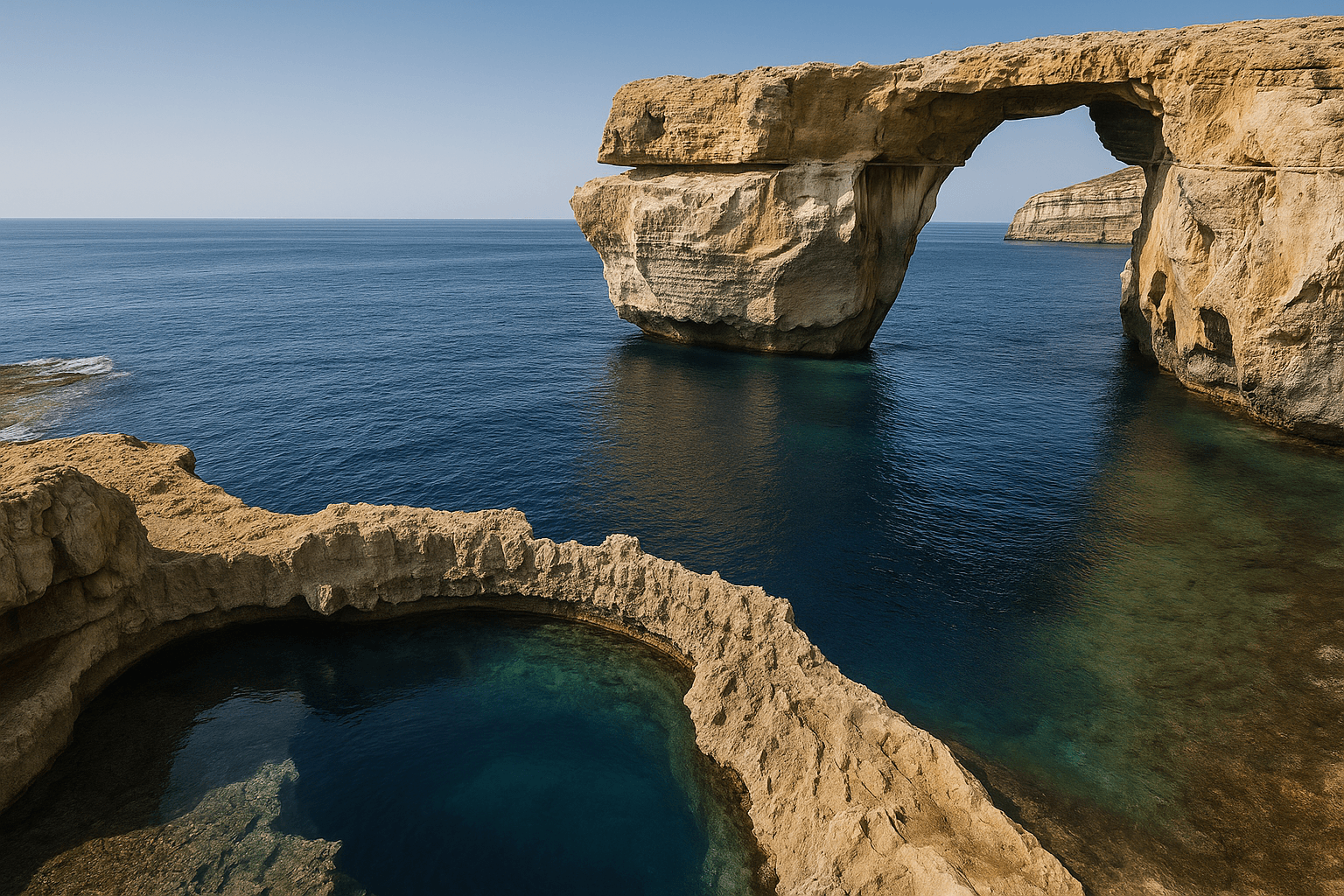
The Blue Hole at Dwejra is the dive that put Gozo on the map, and it earns the reputation. A collapsed cave on the island's west coast has left a natural rock pool roughly ten metres across, sheltered from the open sea and connected to it by an underwater archway. You clamber across the weathered limestone, giant-stride into flat-calm water, drop down the shaft, and swim out through the window into open blue. Few dives anywhere start with a better first minute.
Outside the arch, the terrain keeps giving. The rubble of the Azure Window, the famous rock arch that collapsed in a storm in March 2017, now lies just north of the exit as a jumble of house-sized boulders full of swim-throughs, already colonised by groupers, moray eels and octopus. There is also a cave under the seaward lip of the hole itself worth poking a torch into, and on the return you can hang in the pool watching parrotfish graze the walls while you offgas. Be warned: this is one of the most visited sites in the Mediterranean, so arrive early in summer, and skip it entirely when west or northwest swell is running, because the tunnel amplifies surge and the walk-in across the rock becomes genuinely hazardous.
2. Inland Sea
- Difficulty: Intermediate
- Type: Shore dive (beach entry)
- Depth: 15–24m (50–80ft)
- Visibility: Typically 25–35m (80–115ft)
A few hundred metres from the Blue Hole, the Inland Sea is a shallow lagoon trapped behind Dwejra's cliffs, ringed by fishermen's boathouses. The locals call it Il-Qawra, and the dive is the tunnel: a natural fissure running roughly 80 metres through the rock face, wide enough for the small tourist boats that share it with divers. You wade in off the pebbles in a metre or two of water, follow the tunnel floor as it slopes away beneath you, and watch the far end grow from a pinprick of blue into a full widescreen exit onto the open Mediterranean. The transition from murky lagoon to gin-clear open sea happens in the space of a few fin kicks.
At the seaward mouth the seabed sits at around 24m (80ft) and the walls fall away steeply in both directions, so you can turn left or right and wall-dive along cliffs dotted with corals, sponges and cardinalfish before returning through the tunnel. The view back towards the exit, with divers silhouetted against the light shaft, is one of the classic photographs in Mediterranean diving. Stay near the tunnel sides and bottom on the way through, as boats do pass overhead, and give this one a miss in strong westerlies, which drive surge straight up the fissure.
3. Reqqa Point
- Difficulty: Intermediate
- Type: Boat dive
- Depth: 30–40m (100–130ft)
- Visibility: Typically 25–35m (80–115ft)
Reqqa Point is Gozo's northernmost finger of rock, and the diving matches the drama of the setting. The walls here are genuinely vertical, dropping into deep water almost immediately, with caves and swim-throughs cut into the rock face at various depths. There is no gentle slope to ease you in; you descend along sheer limestone with the blue below and the cliff above, which is exactly why divers who like big topography keep coming back.
The exposure that makes the site spectacular also makes it fickle. This stretch of coast takes the full force of north and northwest weather, deep water starts immediately offshore, and currents around the point can pick up with little warning, so it is one to dive on settled days or when southerlies flatten the north coast. Your reward is the best fish action on Gozo: schooling barracuda off the point, dentex and amberjack patrolling mid-water, and dusky groupers holding territory along the wall. Keep an eye on your depth and your gas, because sheer walls in 30-metre visibility make 40 metres feel like ten, and the blue below is endless.
4. Comino Caves (Santa Marija Caves)
- Difficulty: Intermediate
- Type: Boat dive
- Depth: 20–30m (65–100ft)
- Visibility: Typically 25–35m (80–115ft)
The Comino Caves, better known locally as the Santa Marija Caves, are a honeycomb of interconnecting caverns and swim-throughs on Comino's north coast. This is cavern diving at its most forgiving: daylight is visible from almost every chamber, the passages are wide, and shafts of sunlight cut through openings in the rock to create the light effects the site is famous for. No overhead-environment training is needed, just decent buoyancy and a torch.
The other reason everyone dives here is the fish. Generations of dive guides have fed bread to the resident shoals of white bream, and the result is a wall of silver that engulfs divers the moment they drop in, utterly unbothered by bubbles. It makes for ridiculous photographs, and it is the rare dive that works equally well for a nervous newcomer and a jaded photographer. The site faces north, so it needs settled weather or southerly winds, and the caves can channel surge when swell is running from the north or northeast. On a calm summer day, though, few dives in the Mediterranean are this purely fun.
5. Cirkewwa
- Difficulty: Intermediate
- Type: Shore dive
- Depth: 20–35m (65–115ft)
- Visibility: Typically 25–35m (80–115ft)
Cirkewwa, next to the Gozo ferry terminal at Malta's northern tip, is the busiest dive site in the country for a simple reason: nowhere else offers this much from a single shore entry. Two purpose-sunk wrecks sit within swimming distance of the entry points. The Rozi, a tugboat scuttled in 1992, rests upright and largely intact at around 34m, while the P29, a former East German patrol boat sunk in 2007, stands nearby at a similar depth with its gun platform still recognisable on the bow.
The wrecks are only half the site. The reef between them is cut with a fine natural arch at recreational depth, a statue of the Madonna placed in a rocky niche by local divers, and sheltered pools close to the entry that dive schools use for training. Moray eels and octopus live in the reef cracks, and the sand between the wrecks is worth scanning for flying gurnards. You could dive Cirkewwa four times and run a different route each time, which is exactly what Maltese instructors do all season. The point faces northwest, straight into the prevailing wind, so entries get tricky in any real swell; check the forecast before hauling tanks down the ladder, especially in winter.
6. Um El Faroud
- Difficulty: Advanced
- Type: Shore dive (stair entry)
- Depth: 30–36m (100–120ft)
- Visibility: Typically 25–35m (80–115ft)
The Um El Faroud is the best wreck dive in Malta, and many would say in the Mediterranean. This 110-metre Libyan oil tanker was destroyed by a gas explosion during maintenance work in Malta's drydocks in 1995, a disaster that killed nine dockyard workers, and was scuttled off Wied iz-Zurrieq in 1998 as an artificial reef and a memorial to them. She sits upright on sand at 36m, so big that you cannot see one end from the other even in Maltese visibility.
Winter storms have since broken the hull in two, which only added interest: the split lets light into the interior and gives trained wreck divers clean penetration routes through the superstructure. The bridge, the massive stern and the propeller are the highlights, with barracuda often stacked in the water column above the deck and groupers loitering in the shadows below the hull plates. Access is down the slipway steps at Wied iz-Zurrieq followed by a short surface swim, and the site is well protected whenever the wind has any north in it. Take nitrox if you are certified for it, because at these depths bottom time on air disappears fast, and a wreck this size deserves every minute you can give it.
7. HMS Maori
- Difficulty: Intermediate
- Type: Shore dive (stair entry)
- Depth: 14–15m (45–50ft)
- Visibility: Typically 25–35m (80–115ft)
HMS Maori is the wreck with the biggest story at the smallest depth. This Tribal-class destroyer was part of the flotilla that hunted down the Bismarck in 1941, only to be sunk at her moorings in Grand Harbour by German bombing in February 1942. After the war the hulk was scuttled in St Elmo Bay below Valletta's fortifications, where the bow section now rests on sand in barely 14m (45ft) of water, an easy stair-entry shore dive from the capital itself.
Eighty years of storms have flattened much of the hull, but the gun mountings and bow structure remain recognisable, and the wreck has become a genuine oasis on the sandy bay floor. Look closely and the Maori delivers some of the best critter diving in Malta: octopus wedged into the plating, nudibranchs, fireworms, and moray eels in the wreckage, which also makes this a superb night dive when the resident life comes out to hunt. At this depth a single tank stretches well past the hour, so it is the ideal second or third dive of the day. Surge builds quickly when northeast weather pushes into the bay, so save it for calm days.
8. HMS Southwold
- Difficulty: Advanced (technical)
- Type: Boat dive
- Depth: 65–70m (215–230ft)
- Visibility: Typically 25–35m (80–115ft)
For qualified technical divers, HMS Southwold is the crown jewel of Malta's deep wrecks. This Hunt-class escort destroyer struck a mine off Marsaskala in March 1942 while protecting one of the desperate convoys that kept besieged Malta alive. The blast broke her in two, and the sections now lie a few hundred metres apart on the sand at 65–70m, remarkably well preserved, with guns, depth-charge throwers and deck fittings still in place.
This is unambiguously a trimix dive: open sea, frequent current, and depths that demand proper decompression planning and a charter operator who knows the site. It is also the entry point to a whole ladder of technical wrecks around the islands. The submarine HMS Stubborn sits off the north coast at 50–55m, and the WWI battleship HMS Russell waits beyond 100m for those with the training. Few places in Europe let you build a deep-wreck career this systematically.
Planning Your Malta Dives
Malta is one of the easiest dive destinations in Europe to organise. Fly into Malta International Airport, hire a small car, and you can be at a dive site within forty minutes of leaving the terminal. Dive centres across the islands rent full kit and fill tanks for independent shore divers, and certified buddy pairs are free to dive the shore sites unguided, which keeps costs low for a week of intensive diving. Gozo is a 25-minute ferry ride from Cirkewwa with crossings running day and night in season, so basing yourself on either island still leaves the whole archipelago in reach. English is an official language, which removes the last bit of friction from organising fills, boats and last-minute plan changes.
- Wind decides everything: pick your coast each morning based on the forecast, not the guidebook
- Shore diving: hire a car, rent tanks and weights locally, and use the slipways and ladders at marked entry points
- Beginner-friendly picks: Xlendi Bay on Gozo, Ghar Lapsi in the south, and Comino's Blue Lagoon all stay under 20m in protected water
- Deep wrecks: the Southwold, Stubborn and Russell require technical certification and a specialist charter
- Thermal protection: 3mm in high summer, 5–7mm in the shoulder seasons, drysuit from December to April
- Comino logistics: the caves and lagoon are boat dives, so book with a centre running daily trips across the channel
A week is enough for a serious sampler: two days at Dwejra and the north Gozo walls, a boat day at Comino, a day on the Cirkewwa wrecks, and the Um El Faroud and Maori from the mainland, with a rest-day wander around Valletta in between. Keep your schedule loose rather than pre-booking every slot, because the divers who get the best out of Malta are the ones who follow the forecast. Technical divers should plan charters early, as the deep wreck boats fill up fast in the summer months and wait for stable weather windows.
Three Islands, One Dive Trip
Very few destinations let you swim through a collapsed cave at breakfast, feed bream inside a sunlit cavern at lunch, and drop onto a 110-metre tanker in the afternoon, all on shore-diving logistics and Mediterranean visibility. Malta, Gozo and Comino compress an entire diving career into a hundred square kilometres of sea: a new diver can log formative dives at Xlendi or the Blue Lagoon while a trimix team decompresses off the Southwold a few miles away. The sites in this guide are only the headline acts, and half the pleasure of a Malta trip is stumbling onto the supporting cast.
Ready to dive? Check current conditions for all the sites in this guide on DiveLine's Gozo page and start planning your route around the wind.